- City
- Toronto
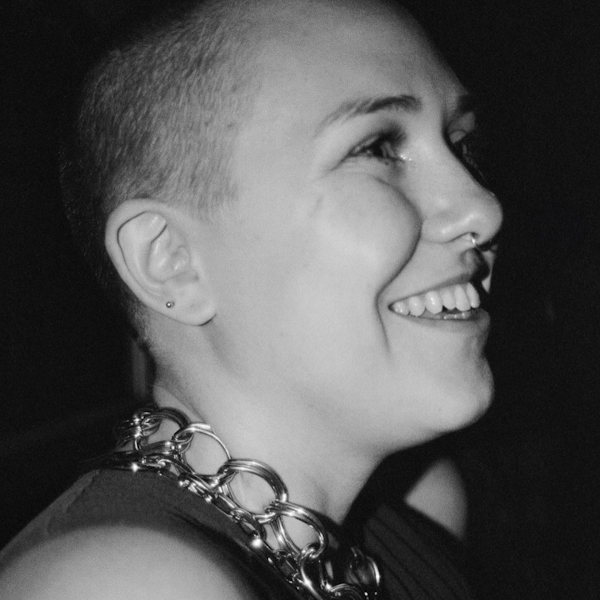
Georgia Whist
Artist Biography
Georgia Whist is an experimental, visual artist based in Tkaronto (Toronto). After leaving a career in engineering in 2022 and healing from the attendant burnout, their art has been a means through which to reflect on modern life's impact on societal and individual wellness. Whist experiments with numerous materials and methods (for example: acrylic paint, acrylic sand mediums, soldering, found objects, resin casting, etc.) to create their work, and has embraced the creative technique of automatism, whereby one forgoes conscious control in order to explore the intangibles of mental health and life. Like alchemy, which blends science and philosophy towards the goal of unraveling the mysteries of the universe and achieving various physical/spiritual transformations, Whist seeks to transmute their materials. Instead of lead into gold their aim is to collaborate with found/trashed material in order to magnify the intricate complexity of being on 21st century Earth.
Project Statement - Neuropil
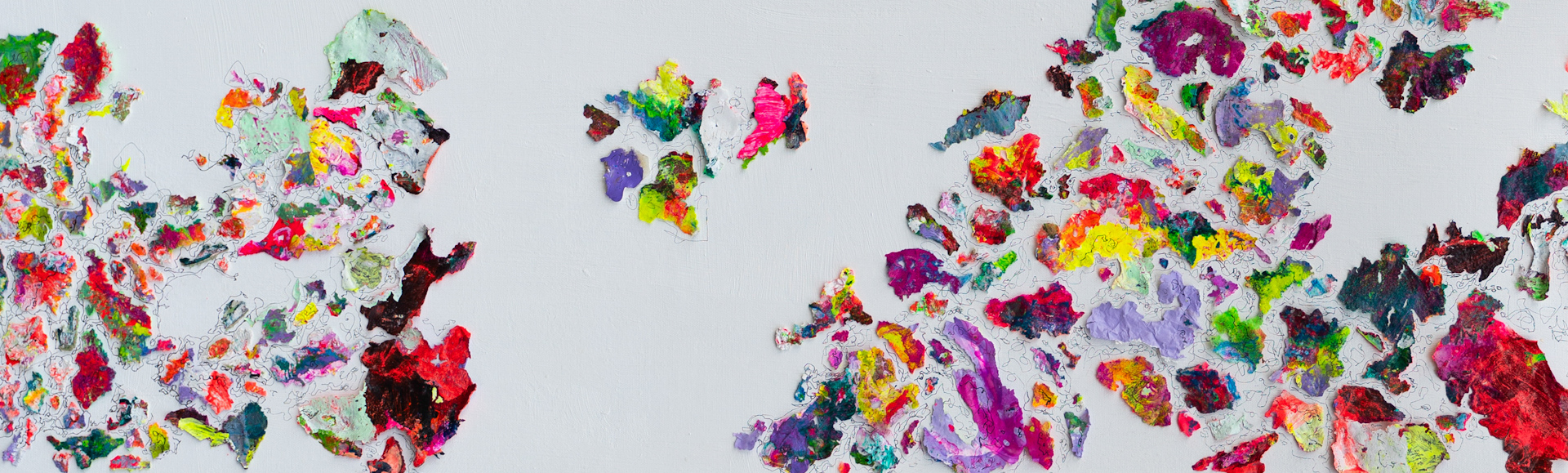
In 2016 I created my first "Neuropil" by collaging dried acrylic paint scraps (or skins) onto paper. Marks made with ink pen connect these acrylic fragments, forming a dense network reminiscent of the biological circuitry found in our brains. While working on other projects I leave my palettes uncleaned, saved for another day - subconscious detritus to create another “Neuropil”. This project is also personal; the neuropil is a part of our brain, whose malfunction is theorized to be associated with Alzheimers, a disease my grandmother lived with for many years.
This series forms my first and (longest running) body of artistic work. They are representative of a shift in worldview that I experienced in the ten years since I began making them, teaching me to embrace working intuitively by entering a flow state without fore-planning or defined rules. I was raised in an environment that upheld Western materialism (especially as shaped by Enlightenment rationalism), which values the measurable, the empirical, the quantifiable - and sees knowledge as a linear path to mastery (which was similarly emphasized in my engineering education and career). I found it destabilizing to realize that deep inquiry doesn’t necessarily yield clarity, the paradox of knowledge being that the more we learn, the more clear it is how little we actually know. This embrace of humility in learning was concurrent with a breakthrough in my arts practice. The ambiguity, mystery, and awe that I was beginning to verbalize had already emerged in my art, and I refused to force my practice anymore.
The intricacy of the Neuropils is an important part of my process, as well an avenue through which I attempt to translate my affective experience for the viewer. I find that the state of intense focus I enter when creating the intricate details in my work is soothing, acting as a signal to my body that calms my nervous system. The act of looking at such intricacies can create similar conditions for deep focus, wherein the viewer is continually drawn into the work, able to notice something anew. In my art, I have found a way to experience the intangible and the mysterious - not as a flaw in knowledge, but as a different mode of truth. Art has become a portal, allowing me to engage with that which cannot be proven but can be felt. My aim is that through the intricacy of my work the audience can be drawn in and sense this too.
Note: All works on paper are framed using salvaged or reclaimed materials, giving new life to found objects and reducing waste bound for landfills (excluding as noted)